
Description
The histochemical antibody for 5-HT1A receptor is generated in a rabbit against synthetic peptide sequence corresponding to amino acids 294-312 of the rat 5-HT1A receptor. The antiserum is provided as 100 µl of affinity purified serum containing 1% BSA. Controls: The ImmunoStar 5-HT1A receptor antiserum was quality control tested using standard immunohistochemical methods.
The antiserum demonstrates strongly positive labeling of rat cortex, arcuate and hippocampus using indirect immunofluorescent and biotin/avidin-HRP techniques. Recommended primary dilutions are 1/200 – 1/300 in PBS – Bn/Av-HRP detection. Intensification methods such as nickel will approximately double the dilution factor as recommended.
The antibody was characterized by immunohistochemistry and Western blot. Western blot showed a single band of approximately 45 kD using a dilution of 1/100. Due to the difficulty with receptor antibodies, western blot applications are not warranted and are included as specificity information only. Preincubation of the antibody with an excess of the synthetic peptide blocked staining. Immunohistochemical staining of rat brain correlates well with Northern analysis, in situ hybridization and receptor autoradiography.
BlastP database sequence homology searches confirmed that this sequence is unique to rat, mouse and human 5-HT1A receptors.
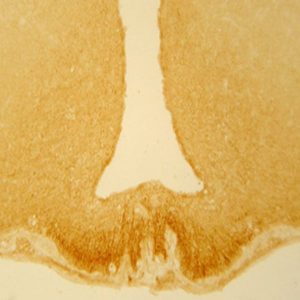
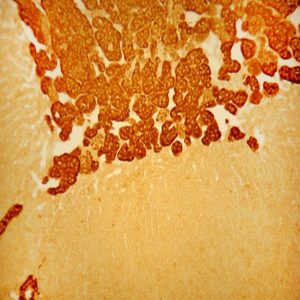
Photo Description: IHC image of neurons staining for the 5-HT1A receptor in the rat cortex (above) and 5HT1A receptor staining of astrocytes in the rat hippocampus (below). The tissue was fixed with 4% formaldehyde/0.05% glutaraldehyde in 0.1 M phosphate buffer, before being removed and prepared for vibratome sectioning. Floating sections were incubated at RT in 10% goat serum in PBS, before standard IHC procedure. Primary antibody was incubated at 1:500 for 48 hours, goat anti-rabbit secondary was subsequently added for 1 hour after washing with PBS. Light microscopy staining was achieved with standard biotin-streptavidin/HRP procedure and DAB chromogen.

Host: Rabbit
Quantity / Volume: 100 µL
State: Liquid
Availability: In Stock
Reacts With: Guinea Pig, Human, Monkey, Mouse, Rat
Alternate Names: 5-hydroxytryptamine receptor 1A; ADRB2RL1; ADRBRL1; RAT5HT1A, 5-hydroxytryptamine (serotonin) receptor 1A, G protein-coupled, anti-5-HT 1A
RRID: AB_572210
Immunogen: Rat 5-HT1A receptor (294-312)
Gene Symbol: Htr1a
Database Links:
Entrez Gene: 100301563 Guinea Pig
Entrez Gene: 3350 Human
Entrez Gene: 694991 Monkey
Entrez Gene: 15550 Mouse
Entrez Gene: 24473 Rat